The Hidden Stress Behind Driving an Electric Vehicle
Switching to an electric car is an exciting milestone for most drivers. You love the silent cabin, the instant acceleration, and the feeling of leaving the gas station behind for good.
I will never forget my first weekend road trip in my brand new electric car. I spent the entire three-hour drive staring at the battery meter in a total panic, sweating nervously instead of actually enjoying the smooth ride. My wife finally told me to stop sighing every time the range dropped by a single mile, which made me realize I desperately needed to learn how this machine actually worked.
However, that initial excitement often fades the moment you take your first long road trip. You start staring at the battery percentage dropping faster than you expected.
Every time you press the brake pedal in a traditional way, you are literally throwing away valuable driving range. The constant worry about making it to the next charging station creates a heavy knot in your stomach.
This feeling is famously known as range anxiety, and it turns a joyful driving experience into a stressful math equation. You want to get the most out of your battery, but the mechanics behind energy saving feel like a confusing maze.
Why Finding Clear Answers Feels Impossible
When you try to figure out how to drive more efficiently, you are often met with terrible advice. Dealerships hand over the keys without ever explaining the car's most important features.
You turn to the internet, only to be buried in highly technical jargon that makes no sense to an everyday driver. This lack of clear guidance leads to several frustrating outcomes:
- Confusing Dashboard Settings: You see options for "High" or "Low" energy recovery but have no idea which one saves more power in the city.
- Forum Misinformation: You read online forums where self-proclaimed experts argue endlessly about coasting versus braking, leaving you more confused than before.
- Wasted Potential: You end up driving your advanced electric car exactly like an old gas car, completely missing out on free energy.
- Fear of Breaking Things: Many drivers mistakenly believe that using heavy motor braking will damage the battery or wear out the car faster.
The Silent Drain on Your Peace of Mind
Driving should be about freedom, not a constant state of mild panic. When you do not understand how your vehicle manages power, that lack of knowledge quietly destroys your confidence on the road.
You start second-guessing every single route you take. This mental burden impacts your daily life in very specific ways:
- Highway Hesitation: You become afraid to drive at normal highway speeds, knowing that pushing the pedal drains your range heavily.
- Stop-and-Go Frustration: Heavy traffic becomes a nightmare because you think all that starting and stopping is killing your battery life.
- Temperature Paranoia: You shiver in the winter because you are too scared to turn on the heater, fearing you will not make it home.
- Lost Trust: Ultimately, you lose trust in your vehicle's stated range, making every trip feel like a risky gamble instead of a smooth journey.
Master the Art of Recovering Lost Energy
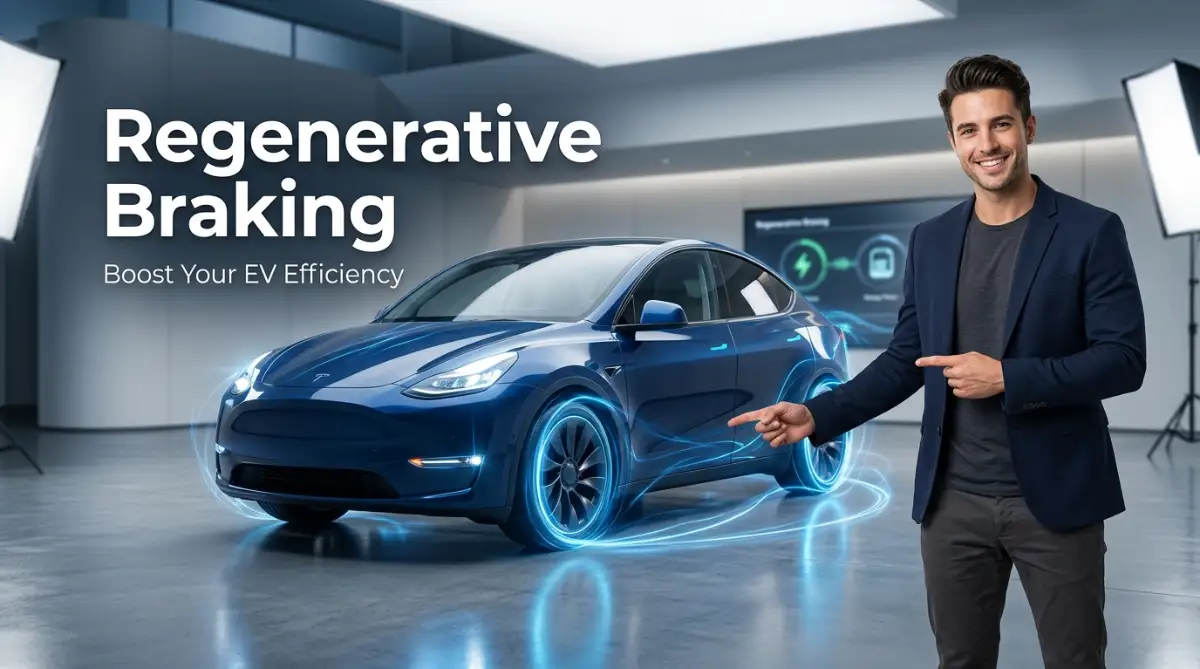
If you want to eliminate range anxiety entirely, you need to understand the most powerful tool your electric car has to offer. That tool is regenerative braking.
Think of this feature as a secret power bank that constantly refills your main battery while you drive. Once you understand the mechanics behind it, your entire perspective on driving will change.
You will stop seeing traffic lights and stop signs as obstacles. Instead, you will start seeing them as opportunities to grab free miles for your journey.
The Science of Capturing Forward Momentum
To truly appreciate this technology, we need to look at what happens when you try to stop a heavy moving object. When driving a standard gas-powered car, your vehicle builds up a massive amount of forward momentum, known as kinetic energy.
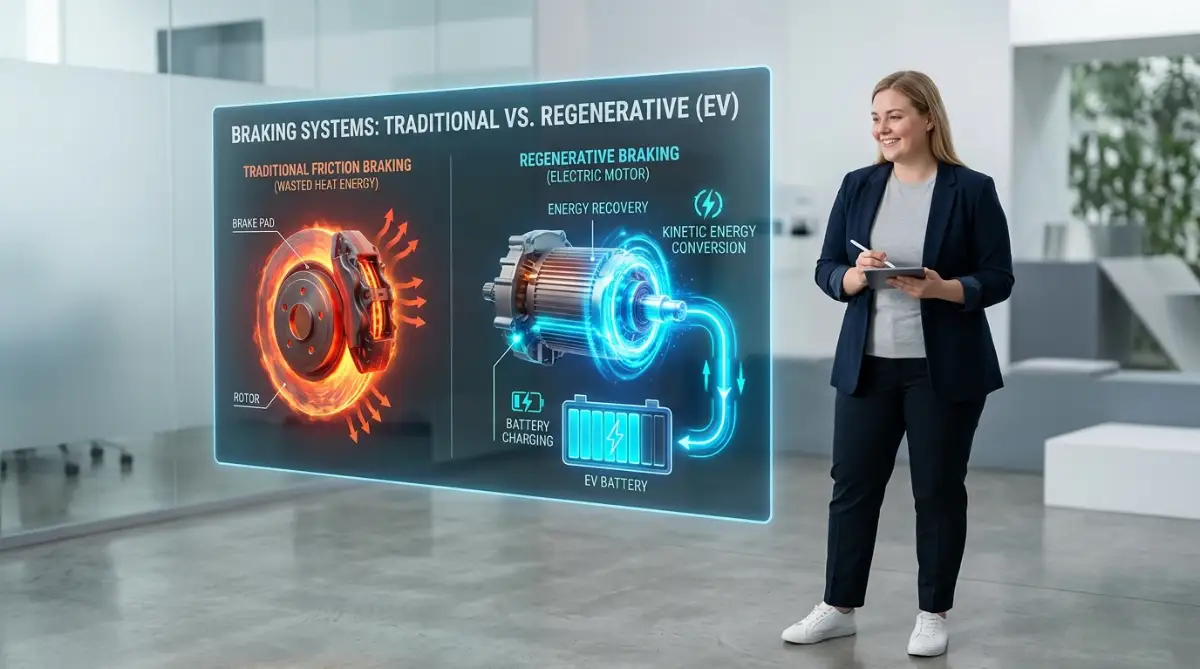
When you press the brake pedal in an older car, metal pads clamp down on a steel rotor to force the wheels to stop. This brutal friction generates extreme heat.
All of that forward momentum is simply burned off into the open air as completely wasted energy. Regenerative braking completely flips this wasteful system upside down.
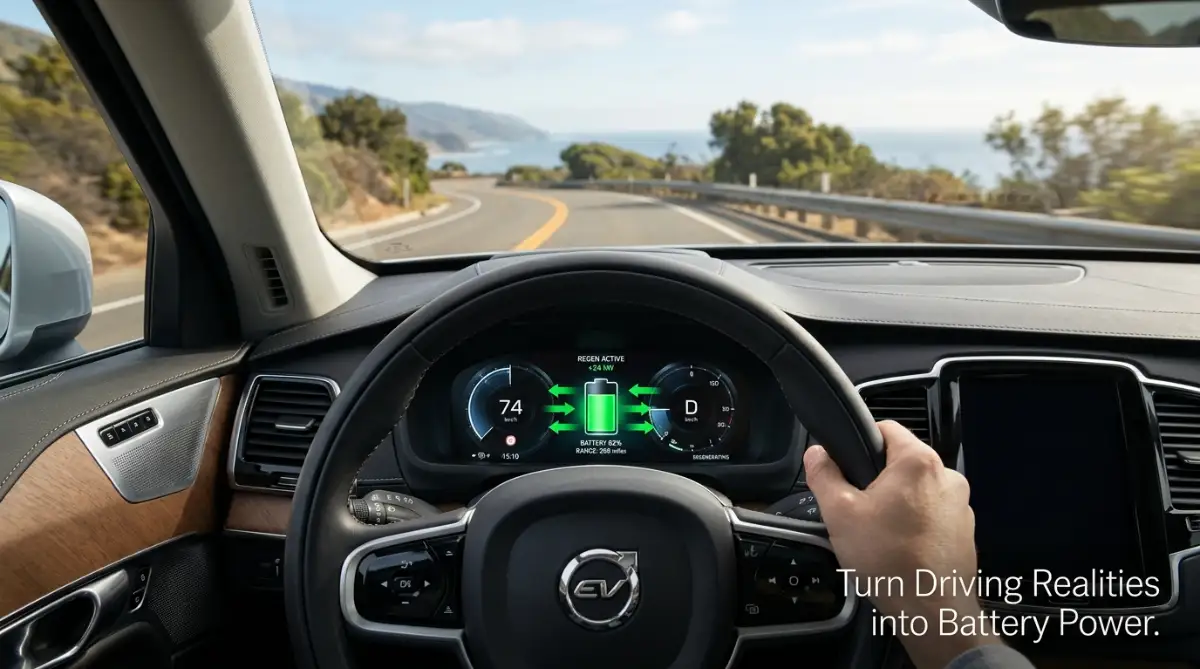
Instead of creating useless heat, an electric vehicle uses its own motor to slow the car down. The system cleverly captures that forward momentum and converts it directly into usable electricity.
An Analogy: The Bicycle Dynamo Effect
Let me explain this using a very simple real-world analogy. Have you ever ridden a bicycle that has a small dynamo light attached to the front wheel?
When you flip the dynamo against the tire, the turning wheel spins a tiny generator inside the light. You immediately notice that pedaling becomes slightly harder, right?
That resistance happens because your physical energy is being converted into electricity to power the bulb. An electric vehicle does the exact same thing, just on a much larger scale.
When you take your foot off the accelerator pedal, the car reverses the role of the electric motor. The motor stops consuming power to push the car forward, and instead, it acts as a giant generator. The resistance of the generator spinning creates a braking force that slows you down smoothly.
Expert Insight: Protecting Your Traditional Brakes
Pro Tip for EV Owners: Because the electric motor does about 80% to 90% of the slowing down, your physical brake pads are rarely used. Many electric vehicle owners drive for over 100,000 miles before ever needing a brake pad replacement. You are not just saving battery power; you are saving hundreds of dollars on maintenance costs!
Step 1: Adopting the One-Pedal Driving Lifestyle
The most practical way to improve your electric car's efficiency is to master one-pedal driving. Almost every modern electric vehicle offers this incredible feature.
When one-pedal driving is turned on, you only need to use the accelerator pedal for your daily commute. You push down to go faster, and you simply lift your foot to slow down.
If you lift your foot completely off the pedal, the car will come to a complete and safe stop. It takes a few days for your brain to adjust to this new driving style.
If you are having a hard time picturing how to stop safely without touching the brakes, watch the short video below to see one-pedal driving in real life, and then keep reading to find out which simple dashboard setting will give you the most free miles.
However, once you get the hang of it, you will never want to go back to moving your foot back and forth between two pedals. Your foot rests comfortably in one spot, making heavy traffic surprisingly relaxing.
Actionable Advice for Beginners:
Start practicing one-pedal driving in a quiet, empty parking lot. Drive up to 15 miles per hour and completely release the accelerator. Pay close attention to how quickly the car slows down so you can build muscle memory.
When I first tested one-pedal driving, I made the terrible mistake of lifting my foot way too fast, which gave everyone in the back seat sudden motion sickness. I quickly realized that treating the pedal like a gentle volume dial, rather than a quick on/off switch, completely fixed the problem. Once I mastered that smooth foot movement, heavy traffic became incredibly relaxing instead of stressful.
Step 2: Customizing Your Resistance Settings
Every driver has a different preference when it comes to how their car feels on the road. Thankfully, automakers allow you to adjust how aggressive the energy recovery system feels.
Usually, you can select between a "Low," "Medium," or "High" setting right from your dashboard menu. Choosing the right setting for your specific driving environment is highly important for maximum efficiency.
If you are driving in a dense city with lots of traffic lights and stop signs, you should always choose the "High" setting. The aggressive motor resistance will capture massive amounts of energy every time you stop.
Your battery will literally recharge itself as you navigate from block to block. This is why many electric cars actually get better range in the city than they do on the highway.
Myth vs Reality: The Highway Coasting Debate
There is a very common misunderstanding among new owners regarding highway driving. Let us clear up this confusion right now.
- The Myth: Keeping regenerative braking on the maximum setting is always the best way to save battery, even on long, open highways.
- The Reality: On an open highway with no traffic, capturing energy is actually less efficient than maintaining your forward momentum.
When you are traveling at 70 miles per hour, wind resistance is already working hard against your car. If your settings are too aggressive, every tiny adjustment of your foot will slow the car down sharply.
The motor will then have to use extra battery power to get you back up to cruising speed. For long road trips, switching your settings to "Low" allows the car to coast smoothly. Coasting requires zero energy, which is mathematically the most efficient way to travel long distances.
Step 3: Anticipating the Road Ahead
Technology can only do so much; your personal driving habits are still the biggest factor in battery efficiency. The absolute best way to use this feature is to look far down the road while driving.
If you see a red light a quarter-mile ahead, do not keep your foot on the gas until the last second. Instead, gently ease off the accelerator early.
Allow the motor to slowly capture that energy over a long distance. This gradual slowing process harvests the maximum amount of electricity possible .
If you wait too long and have to slam on the physical brake pedal, you lose all of that potential power. The physical brakes will take over, turning your precious momentum into useless heat. Smooth, predictable driving will always reward you with extra miles on your dashboard display .
Next-Level Strategies for Maximum Battery Range
You have mastered the basics of one-pedal driving, but there is still so much more performance hiding in your car. Taking your driving skills to the expert level requires understanding how your battery behaves under different conditions. The physical state of your battery directly controls how much power the motor can grab from the wheels.
Most drivers completely misunderstand the relationship between a fully charged car and energy recovery. I see this happen all the time with new owners who charge their cars overnight to the absolute maximum.
The Full Battery Dilemma
Imagine trying to pour water into a glass that is already filled to the very top. The water will just spill over the edges, completely wasted. Your electric motor treats your battery exactly the same way when it is fully charged.
If you start your morning commute with a battery sitting at 100%, the energy recovery system simply cannot work. There is nowhere for that generated electricity to go. Because the system turns off automatically to protect the battery cells, your car will feel completely different when you lift your foot off the pedal.
Instead of slowing down smoothly, the vehicle will just keep rolling forward aggressively. This catches many new drivers by surprise, forcing them to slam on the physical brakes in a panic. You are suddenly burning up those physical brake pads and losing all that valuable momentum.
To avoid this dangerous and inefficient scenario, simply set your daily home charging limit to 80% or 90%. This gives the battery plenty of empty room to absorb free energy the moment you back out of your driveway. Treating your battery with this level of care is just like taking steps to naturally keep your digital assets safe with a complete cold wallet guide. Both require proactive planning to protect your high-value investments.
Navigating Cold Weather Challenges
Temperature plays a massive role in how well your electric motor performs as a generator. Batteries are essentially chemical boxes, and those chemicals get very sluggish when the temperature drops below freezing.
On a freezing winter morning, your car will intentionally limit the amount of power it accepts to prevent internal damage.
You will notice a small warning light or a dotted line on your dashboard indicating reduced performance. During these chilly drives, you will have to rely much more heavily on your traditional brake pedal to stop.
The smartest workaround is to pre-condition your car while it is still plugged into the wall at home. By turning on the heater remotely, you warm up the battery pack using electricity from your house, not the car.
A warm battery is a happy battery, and it will be fully ready to capture moving energy the second you hit the road.
Understanding these technical limits is exactly like learning how to effectively master your health policy deductibles. When you know the maximum limits of the system, you are never caught off guard by unexpected performance drops.
The Art of Blended Braking
Not every stop can be planned perfectly, and sometimes you have to press the physical brake pedal. However, many modern electric vehicles use a brilliant software feature called blended braking.
When you press the brake pedal lightly, the car does not immediately squeeze the metal brake pads.
Instead, the computer asks the electric motor to apply extra resistance first. It only engages the traditional friction brakes if you push the pedal down hard for an emergency stop.
According to experts at the U.S. Department of Energy, utilizing these smart driving techniques correctly can significantly increase your overall travel range.
This means you should always strive for long, gentle presses on the brake pedal rather than short, sharp stomps.
Real-World Questions From Everyday Drivers
Many people still have lingering doubts about this unique braking technology. Let us clear up some of the most common worries I hear from everyday drivers.
Will heavy motor resistance cause my passengers to get car sick?
This is a very valid concern for families. Yes, if you abruptly pull your foot off the pedal at high speeds, the sudden jolt can be uncomfortable for people in the back seat. The secret is simply learning to lift your foot slowly and smoothly, allowing the car to decelerate gently.
Do my brake lights still turn on if I am not pressing the brake pedal?
Absolutely. Your car has highly intelligent sensors built into the accelerator system. When the computer detects that the car is slowing down rapidly through motor resistance, it automatically turns on your bright red brake lights to warn drivers behind you.
Does using this feature wear out the electric motor faster?
Not at all. Electric motors are brilliantly simple machines with very few moving parts compared to gas engines. Reversing the flow of electricity to act as a generator is completely natural for the motor and causes zero extra wear or tear on the system.
Everyday Driving Habits Ruining Your Efficiency
Even with the best intentions, it is incredibly easy to fall into bad habits that secretly drain your power. When we transition from traditional gas cars, we bring years of muscle memory with us. Unfortunately, some of those old habits actively fight against the advanced technology sitting under your hood.
Let us look closely at the most common pitfalls that steal your range and put unnecessary wear on your vehicle. Fixing these small mistakes will dramatically transform your daily driving experience.
Treating the Pedal Like an On/Off Switch
The absolute worst thing you can do in an electric vehicle is to bounce your foot heavily on the accelerator. Some drivers constantly push the pedal down to speed up, then completely let go, then push it down again. They treat the pedal like a light switch instead of a sensitive volume dial.
This aggressive see-saw motion creates a terrible, jerky ride that will make your passengers feel completely sick. More importantly, it constantly forces the motor to switch back and forth between spending power and saving power. This rapid switching is incredibly inefficient and drains the battery much faster than smooth, steady driving.
You must learn to feather the pedal with tiny, smooth adjustments. Finding that perfect middle spot where the car is neither accelerating nor slowing down is the ultimate sweet spot for efficiency. Building this smooth driving discipline requires patience, much like the steady financial habits needed to improve your credit score fast.
Ignoring the Impact of Tire Resistance
Many drivers obsess over their dashboard settings but completely ignore the black rubber rings touching the actual road. Your tires dictate exactly how easily your car rolls down the street. If your tire pressure is even slightly too low, the rubber spreads out and creates massive rolling resistance.
When your car has to fight against flat tires, it naturally slows down much faster than it should. The electric motor has to work twice as hard to get you moving again, wiping out any energy you just saved. You could be executing perfect one-pedal driving, but under-inflated tires will quietly destroy all your hard work.
Make it a weekly habit to check your tire pressure manually, ensuring it matches the exact number printed inside your driver-side door. Automotive testing professionals at Consumer Reports consistently warn that ignoring basic tire maintenance is the fastest way to ruin your car's built-in efficiency.
Following the Vehicle Ahead Too Closely
Tailgating is a terrible idea in any vehicle, but it is an absolute range-killer in an electric car. When you drive right on the bumper of the car in front of you, you constantly have to react to their sudden movements. Their unpredictable driving forces you to stomp on the brakes unexpectedly.
Every time you hit the physical brakes hard, you instantly throw away perfectly good energy as useless heat. You completely bypass the motor's ability to act as a powerful generator. Always leave a large, comfortable gap between your car and the heavy traffic ahead.
This gap acts as your personal safety buffer on the road. It gives you the necessary time to ease off the pedal gently, allowing the motor to harvest maximum power while keeping you perfectly safe.
Your Personal Blueprint for the Next Drive
We have covered a massive amount of ground today regarding how your vehicle interacts with the road. The technology inside your car is a true engineering marvel, designed specifically to save you money and reduce your charging stops. However, that technology relies entirely on your personal driving habits to work its daily magic.
You hold the key to unlocking the absolute best performance your car has to offer. Do not let these concepts just sit in your mind as interesting facts. It is time to turn this educational knowledge into physical muscle memory.
An Actionable Checklist for Tomorrow Morning
Before you head out on your next daily commute, I want you to try a simple experiment. Follow these exact steps to see an immediate, positive difference in your dashboard numbers.
- Check Your Charge: Make sure your battery is not sitting at 100% full. Give your motor the necessary empty room to store newly captured power.
- Set the Mood: Navigate to your dashboard screen and select the highest level of energy recovery available for your specific city route.
- Look Far Ahead: Keep your eyes locked a quarter-mile down the road, actively searching for upcoming red lights or stop signs.
- Ease Off Early: The moment you spot a reason to stop, gently begin lifting your foot instead of waiting until the last scary second.
Once you experience the thrill of watching your estimated range increase while driving, you will be absolutely hooked. Driving becomes a fun, engaging puzzle where you are constantly looking for creative ways to capture free miles.
You no longer have to fear long trips or frustratingly heavy traffic jams. You are now fully equipped to take control of your vehicle's efficiency, ensuring every single trip is smooth, confident, and incredibly cost-effective. Drive safe, and enjoy the rewarding feeling of turning your everyday forward momentum into pure, usable battery power!
Trust me, getting over that initial battery fear completely changes how you feel about your electric car. Once you test out these simple pedal tricks on your way to work tomorrow, you will feel so much more relaxed and confident behind the wheel. Stop letting the dashboard numbers scare you, take a deep breath, and just enjoy the amazing drive!
Disclaimer: The information provided in this comprehensive guide is intended for educational and informational purposes only. Driving conditions, specific vehicle software features, and battery performance may vary greatly by manufacturer. Always consult your vehicle's official owner's manual and rigorously follow local traffic laws before making any major adjustments to your driving habits.
**** THANK YOU FOR READING PATIENTLY***