
The Hidden Stress Behind Choosing the Right Home Loan
I still vividly remember sitting across from my loan officer, staring at a piece of paper filled with changing interest rates and totally freezing up. I almost walked away from buying my first house because I was so terrified of making a wrong choice that would empty my bank account later. It took me weeks of stressful research to finally understand what these numbers meant for my family's future, and I really wish someone had just explained it to me simply back then.
Buying a home should feel like one of the most exciting achievements of your life. You have saved up for a down payment, found the perfect neighborhood, and imagined your family growing in that space.
But the moment you sit down at the lender’s desk, reality hits you like a brick wall. You are suddenly bombarded with confusing financial jargon, shifting interest numbers, and loan structures that seem impossible to understand.
For most normal people, choosing between a standard loan and an adjustable-rate mortgage feels like walking through a minefield blindfolded. The fear of making the wrong choice is paralyzing. You worry that a single mistake could cost you thousands of extra dollars in unexpected payments down the road.
Why do so many smart, hardworking buyers make costly mistakes when choosing their loans? The truth is, people simply cannot find clear answers.
- Information overload: The internet is packed with complicated financial terms that normal people do not use in daily life.
- Biased advice: Many lenders push specific loan products that benefit the bank, not the homebuyer.
- Confusing math: Buyers get overwhelmed trying to calculate future interest rates on their own.
- Fear-mongering: Friends and family often share scary, outdated stories about people losing their homes due to rate changes.
- Lack of transparency: People rarely get a straightforward answer on how much their monthly payment could actually increase.
This ongoing financial confusion does not just stay at the bank. It actively ruins your mental peace and destroys your confidence as a buyer.
- Sleepless nights: You lie awake wondering if your monthly payment will suddenly jump out of your budget.
- Decision paralysis: The fear of choosing the wrong mortgage makes you miss out on great homes.
- Relationship strain: Couples often argue out of pure stress because they cannot agree on which loan feels safer.
- Loss of control: You feel completely at the mercy of unpredictable market changes you cannot control.
- Diminished joy: The happiness of buying a new home is completely overshadowed by heavy financial anxiety.
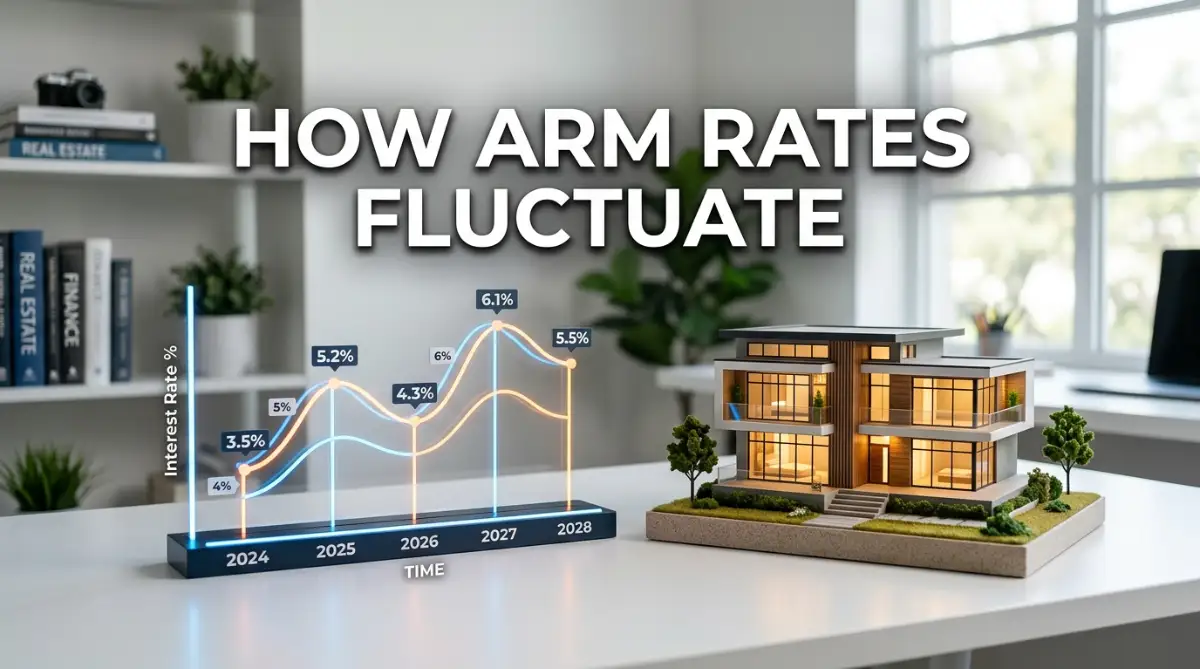
Unlocking the Mystery: What Exactly Is an Adjustable-Rate Mortgage?
Let us take a deep breath and break this down into simple terms. An adjustable-rate mortgage, commonly known as an ARM, is a home loan where the interest rate changes over time. Unlike a traditional fixed-rate loan that locks you into the exact same payment for thirty years, an ARM has a rate that goes up or down.
Think of a fixed-rate mortgage like riding a train. Once you buy your ticket, you know exactly how fast you are going, and the ride is smooth and predictable. You will never be surprised.
An ARM, on the other hand, is like riding a boat on the ocean. Sometimes the water is perfectly calm, and you get a smooth, cheap ride. Other times, the waves pick up, and your ride becomes a bit more expensive and bumpy.
When you first sign up for an ARM, you get an introductory period. During this time, your interest rate is actually lower than what a fixed-rate mortgage would offer. But once that initial period ends, your rate will start adjusting based on the current financial market.
The Core Mechanics: How ARM Rates Actually Change
To really understand how this works, we need to look under the hood of an adjustable-rate mortgage. You might be wondering, "Who exactly decides when my rate goes up?" It is not just a random banker pressing a button.
Your new interest rate is determined by two main parts: the Index and the Margin.
The Index is a basic financial benchmark that reflects the general economy. When the economy is struggling, the index usually drops, which means your interest rate goes down. When the economy is booming and inflation is high, the index goes up, making your loan more expensive.
The Margin, however, is the lender's profit. This is a set percentage that your bank adds on top of the index. While the index changes constantly, the margin stays exactly the same for the entire life of your loan.
So, your fully indexed rate is simply the Index plus the Margin. If the current index is sitting at three percent and your lender has a margin of two percent, your total interest rate will be five percent.
Real-Life Scenario: The Classic 5/1 ARM
Let us make this completely real. Imagine a buyer named Sarah who decides to get a 5/1 ARM. What do those numbers actually mean?
The first number, 5, tells Sarah how many years her initial, low interest rate is locked in. For the first five years, her monthly payment will not change by a single penny. She gets to enjoy a highly predictable budget.
The second number, 1, tells her how often the rate will change after that initial period ends. In this case, it means her interest rate will adjust exactly once every single year.
So, in year six, Sarah's lender will check the current market index. If rates have dropped, her monthly payment will shrink. If rates have climbed, her payment will go up for that specific year.
Myth vs Reality: Clearing the Air About ARMs
The real estate world is full of rumors. Let us clear up some of the most common misunderstandings about variable home loans.
Myth: An ARM will eventually bankrupt you because the rate can skyrocket to fifty percent overnight.
Reality: This is completely false. Today, adjustable-rate mortgages come with strict legal limits called caps that prevent your rate from jumping dangerously high.
Myth: Only desperate buyers who cannot afford a real home use ARMs.
Reality: Many wealthy investors and financially savvy buyers use ARMs on purpose. They take advantage of the lower initial rates to save cash, knowing they will sell the property before the rate ever adjusts.
Myth: Once your rate goes up, it can never come back down.
Reality: ARMs go both ways. If the overall market interest rates drop, your monthly payment will automatically decrease without you ever needing to refinance your home.
The Built-In Safety Net: Understanding Mortgage Caps
Now, let us talk about the most important feature that protects you from financial disaster. These are known as Mortgage Caps. Caps are strict safety limits written into your loan contract.
They exist for one specific reason: to stop your monthly payment from shooting up to an unaffordable level. There are three main types of caps you need to know about.
First is the Initial Adjustment Cap. This rule limits how much your interest rate can change the very first time it adjusts. Usually, lenders cap this first jump at a maximum of two percentage points.
Second is the Periodic Cap. This controls how much your rate can increase or decrease during all the following adjustment periods. Again, this is commonly limited to about two percent per year.
Finally, you have the Lifetime Cap. This is your ultimate safety net. It strictly limits how much your interest rate can increase over the entire life of the loan. Most lifetime caps are set at five percent above your starting rate.
Let us say you start with an initial rate of four percent, and you have a lifetime cap of five percent. This means that no matter how bad the economy gets, your interest rate can never, ever go above nine percent.
Fixed-Rate vs. Adjustable-Rate: A Quick Comparison
Before we look at the written comparison, check out this short video that perfectly explains the real difference between a fixed-rate and an ARM in plain English. It makes the math super easy to understand, and it will definitely help you make more sense of the exact saving strategies I share in the rest of this guide!
Sometimes seeing the facts side-by-side makes the decision much easier. Here is a simple breakdown of how these two popular loan types stack up against each other.
- Initial Interest Rate:
- Fixed-Rate: Usually higher.
- Adjustable-Rate (ARM): Usually lower.
- Monthly Payment:
- Fixed-Rate: Stays exactly the same for the life of the loan.
- Adjustable-Rate (ARM): Changes after the introductory period.
- Long-Term Predictability:
- Fixed-Rate: Very high (No surprises).
- Adjustable-Rate (ARM): Low (Market dependent).
- Best Used For:
- Fixed-Rate: Staying in one home forever.
- Adjustable-Rate (ARM): Short-term living or investing.
- Risk Level:
- Fixed-Rate: Very safe and stable.
- Adjustable-Rate (ARM): Requires careful financial planning.
Pro Tip / Expert Insight
Expert Insight: You should seriously consider an ARM if you plan to move or refinance within the next five to seven years. Why pay a higher fixed interest rate for thirty years if you are only going to live in the house for six? By choosing an ARM, you can pocket the monthly savings during the introductory period. You can then use that extra cash to pay off credit cards, build an emergency fund, or invest in home improvements.
Real-Life Examples: When Does an ARM Make Perfect Sense?
You might be asking yourself, "Who are the people actually choosing these loans?" Let us look at a few practical scenarios where this strategy shines.
Scenario A: The Short-Term Starter Home
Meet David and Jessica. They just got married and want to buy a small starter home. They know they will have kids soon and will need a bigger house in about five years.
Instead of taking a costly fixed-rate loan, they choose a 5/1 ARM. They enjoy extremely low payments for those first five years. By year six, before the rate even has a chance to adjust, they sell the house and move. They completely beat the system.
Scenario B: The Expected Income Jump
Next, look at Michael. He recently graduated from medical school and is starting his residency. Right now, his income is fairly low, but he knows his salary will triple in the next few years.
Michael takes a 7/1 ARM to keep his housing costs as low as possible while his budget is tight. By the time his interest rate finally begins to adjust in year eight, he will be making plenty of money. He can easily afford a higher payment or simply refinance the loan.
Scenario C: The Downward Market
Sometimes, economic experts predict that interest rates are going to drop steadily over the next decade. If you lock yourself into a fixed rate today, you will be stuck paying yesterday's high prices.
With an ARM, your rate will automatically float downward as the market cools off. You get to enjoy cheaper monthly payments without paying heavy fees to refinance your loan.
The Dangers: When Should You Avoid an ARM Entirely?
While variable loans are great tools, they are not for everyone. If you are someone who panics easily about money, this loan will likely cause you massive stress.
Do not choose an ARM if you are buying your forever home. If you plan to retire in this house and live there for the next thirty years, predictability is your best friend. A fixed rate ensures your housing costs stay flat while your retirement income remains limited.
You should also avoid an ARM if your budget is already stretched to the absolute maximum. If an unexpected rate increase of just two percent would make you miss your mortgage payment, an ARM is far too risky for your family.
How to Read Your Loan Estimate Like a Pro
When you apply for a variable loan, your lender will hand you a standardized document called a Loan Estimate. This piece of paper holds all the secrets to your financial future.
You need to look closely at Page Two of this document. Here, you will find a section completely dedicated to your adjustable interest rate.
Always check the "Projected Payments" table. It will clearly show you your best-case scenario and your worst-case scenario. It spells out exactly what your maximum possible monthly payment will be if rates hit the ceiling.
If that worst-case number makes you feel sick to your stomach, you probably need to look for a smaller house or switch to a traditional fixed-rate loan.
The Right Questions to Ask Your Lender Today
Do not just sit quietly and nod your head while the loan officer talks. You are the customer, and you have the right to demand clear answers.
Before signing any paperwork, ask your loan officer exactly what index they are using to calculate your adjustments. Is it the Secured Overnight Financing Rate (SOFR)? Is it a Treasury index?
Next, ask them what their specific margin is. Remember, the margin is their profit. If one bank offers a margin of two percent and another offers three percent, the first bank will give you a cheaper loan in the long run.
Finally, ask them to explain your specific rate caps out loud. Have them write down your absolute maximum lifetime interest rate on a piece of paper so there is no confusion.
Taking control of your mortgage choice is the first step to true financial freedom. By understanding these simple mechanics, you can confidently choose the path that best protects your family and your wallet.
Mastering Your Mortgage: Strategies for the Long Haul
Now that you understand the basic mechanics, we need to talk about long-term survival. Holding an adjustable-rate mortgage requires a bit of active, ongoing management. You cannot simply sign the papers and forget about it for decades.
Let us look at how the real experts handle their variable loans without ever losing sleep. These advanced strategies will keep your household budget completely safe, no matter what the national economy decides to do.
Treat Your Monthly Savings Like a Shock Absorber
The absolute smartest thing you can do during your low-rate introductory period is build a specific financial buffer. Do not just spend the money you are saving on cheaper monthly payments. Instead, redirect those exact savings into a separate, high-yield bank account.
Think of this dedicated account as your personal rate-hike shock absorber. If the market eventually shifts and your monthly mortgage payment jumps by two hundred dollars, you will not panic. You simply pull that extra cost directly from your shock absorber fund every month.
This simple strategy instantly removes the emotional stress from variable-rate borrowing. It gives you total control over your monthly cash flow and protects your peace of mind.
Looking back, my biggest realization was that the lower payment in the first few years of an ARM is not just free money to spend on fun things. I learned that if you automatically put those monthly savings straight into a separate bank account, you build a massive safety net. That way, if your rate ever does go up in the future, you already have a pile of cash ready to cover the difference without feeling any pain.
Keep a Close Watch on Leading Economic Indicators
You do not need to become a Wall Street banker to successfully track your home loan. However, you should definitely pay attention to the specific index tied to your mortgage contract.
Most modern loans are tied to standard financial benchmarks. If you notice inflation rising heavily in the news, your mortgage index will likely follow that same path. You can easily learn more about how these specific economic indexes dictate home loan pricing to stay ahead of the curve.
When you see the index trending upward consistently, it serves as your early warning sign. You now have plenty of time to review your options before your next adjustment period actually hits.
The Art of the Strategic Refinance
An adjustable-rate mortgage is often meant to be a stepping stone, not a permanent destination. Many savvy buyers plan to refinance their loan long before the very first rate adjustment happens.
To pull this off successfully, you need to maintain an absolutely excellent financial profile. Your credit history must be spotless when you go back to the bank for a brand-new fixed-rate loan.
If you are planning a future refinance, you must actively protect your borrowing power today. Taking immediate steps toward improving your credit score fast is absolutely mandatory here. A higher score guarantees you will get the best possible terms when you transition out of your adjustable loan.
Make Aggressive Principal Payments Early
Here is a massive financial secret that average bankers rarely discuss openly. During your initial fixed-rate period, more of your monthly payment naturally goes toward your actual loan principal.
If you add just an extra hundred dollars to your payment every single month, it directly shrinks your core debt. When your loan eventually adjusts, the new interest percentage is applied to a much smaller principal balance.
This clever move naturally lessens the blow of any higher interest rate down the road. You are essentially starving the loan of its base before the bank has a chance to charge you more money.

The Danger Zones: What Financial Traps Must You Avoid?
Even with the best strategies in place, normal people still fall into highly predictable traps. Making a thoughtless mistake with home financing can easily set your wealth-building journey back by a decade.
Let us explore the most dangerous pitfalls modern buyers face. I will show you exactly how you can sidestep them completely.
Trap 1: The "Future Promotion" Fallacy
One of the most dangerous things you can ever do is borrow money based on income you do not have yet. Many eager buyers take out large variable loans because they blindly assume they will get a huge promotion at work soon.
They tell themselves, "By the time the rate adjusts, I will be making double my current salary." This is a massive, unnecessary financial gamble.
If the overall economy slows down and you lose your job, you are stuck with a rising mortgage payment and zero income. Always base your borrowing decisions on your current reality, not a hopeful fantasy. To stay safe, the Consumer Financial Protection Bureau highly recommends always stress-testing your current budget against the maximum possible loan payment.
Trap 2: Ignoring the Fine Print on Caps
We talked earlier about how strict safety limits protect your wallet from exploding interest rates. However, a shocking number of buyers never actually verify their specific numbers in writing.
They falsely assume all adjustable loans have the exact same protections built right in. This is completely untrue. Some aggressive lenders offer higher initial adjustments that can shock your bank account on day one.
You must read your contract carefully before putting a pen to paper. Understanding your mortgage caps is just as critical as knowing how to master your health policy deductibles. Both require knowing exactly what your absolute maximum out-of-pocket costs will be before a disaster strikes.
Trap 3: Forgetting the Hidden Costs of Refinancing
Many people confidently declare, "I will just refinance if the rate gets too high." They completely forget that refinancing is a business transaction, and it is never free .
Closing costs on a brand-new loan can easily eat up several thousands of your hard-earned dollars. You have to pay for fresh appraisals, new loan origination fees, and updated title searches all over again.
If you plan to sell the house shortly after refinancing, you will never recover those upfront closing costs. You must do the exact math to ensure jumping to a fixed loan actually saves you money. For deeper insights on evaluating these heavy expenses, review this expert home financing advice from Forbes.
Trap 4: Treating the Home Like an ATM
When property values rise rapidly, some homeowners get wildly tempted by cash-out refinances. They trade their low-rate initial loan for a new one just to pull out extra spending money.
They use this newly unlocked equity to buy luxury cars, fund extravagant vacations, or buy depreciating electronic items. This habit completely destroys their slowly built-up financial security.
Your home equity is arguably your strongest wealth-building tool. Instead of wasting it recklessly, you should protect it with the same extreme caution you use to keep your digital assets safe from hackers. Treat your property investment with total and absolute respect.
Trap 5: Letting Raw Emotion Overrule Logic
Home buying is inherently emotional because you are choosing a sacred place to live your life. However, your financing choices must remain completely logical, cold, and detached.
Buyers often fall deeply in love with a property that is wildly out of their realistic budget. They choose a risky adjustable loan just to squeeze their initial payments down enough to qualify for the house .
This is a guaranteed recipe for long-term disaster. If you cannot afford the house comfortably on a standard fixed-rate loan, you truly cannot afford the house at all.
Your Ultimate Playbook for Smarter Borrowing
We have covered a massive amount of valuable ground today. You now possess a level of understanding that most typical homebuyers completely lack when walking into a bank.
You know exactly how the index and margin work together seamlessly behind the scenes. You understand the specific safety caps that keep your monthly household budget from exploding unexpectedly.
More importantly, you know that an adjustable-rate mortgage is neither a magic trick nor a financial monster. It is simply a highly specialized financial tool. When used in the exact right scenario, it can save you an incredible amount of money.
Q&A: Answering Your Biggest Remaining Doubts
Before we wrap up this guide, let us address a few lingering questions. These might still be bouncing around your mind as you plan your next move .
What happens if my rate adjusts and I simply cannot afford my new payment?
If your rate adjusts and you literally cannot pay, you must contact your lender immediately. Do not ever hide from their phone calls or letters. Banks would much rather work out a temporary loan modification than go through the highly expensive process of taking your home back.
Can I switch to a different lender when my initial rate expires?
Yes, absolutely. You are never permanently chained to your original bank. When your introductory period nears its end, you can actively shop around and move your debt to any competitor offering better terms.
Is an adjustable-rate loan a good idea for an investment property?
Real estate investors absolutely love variable loans for their rental properties. They use the low initial monthly payments to maximize their cash flow right away. Then, they simply sell the rental building for a profit before the heavy rate adjustments ever kick in.
Your Action Plan for Tomorrow
Knowledge is entirely useless if you do not actively apply it to your real life. As you prepare to talk to lenders, I want you to follow this exact checklist.
First, sit down quietly and honestly evaluate your five-year family plan. Ask yourself exactly how long you truly intend to stay in this specific house before moving again.
Second, run the worst-case scenario numbers through an online mortgage calculator. Look at the absolute highest payment allowed by your lifetime cap and verify it easily fits your current income.
Third, interview at least three different lenders in your local area. Compare their initial rates, their specific index choices, and their underlying profit margins side-by-side.
A Final Word of Encouragement
Buying a home is a deeply personal and rewarding journey. Do not let aggressive bankers or fearful family members push you into a corner you do not like.
You are fully capable of making this massive decision on your own. Take your time, read the fine print twice, and always trust the math over a slick sales pitch.
By approaching your mortgage with open eyes and a clear strategy, you guarantee a much safer financial future for your family. Step into that lender's office with total confidence, knowing you are ready to make the smartest choice possible.
I know exactly how scary it feels to sign your name on a thirty-year loan, but you truly have all the right tools to handle this without fear now. Go ahead and run those worst-case numbers tonight, and start talking to lenders with your head held high tomorrow morning. You are entirely ready to pick the perfect loan and finally move into the beautiful home you have worked so hard for!
Disclaimer: The information provided in this blog post is strictly for educational and informational purposes only and does not constitute financial, legal, or professional advice. Mortgage rates and policies change frequently. Always consult with a licensed financial advisor, certified accountant, or professional mortgage broker before making any major financial or real estate decisions.
THANK YOU FOR READING PATIENTLY