
The Hidden Anxiety Behind Buying Your Dream Home
I still remember pacing around my tiny rented apartment, constantly refreshing my email to see if the underwriter had replied. My hands were sweating because I was so terrified that a forgotten $30 late fee from my college days would ruin my chances of getting approved. I felt completely helpless and sick to my stomach handing over my entire financial life to a total stranger.
Imagine this scenario for a moment. You just found the perfect home, put in a competitive offer, and the seller accepted it. You are already picturing where the furniture will go and how you will paint the living room.
Then, the waiting game begins. Your loan application enters a mysterious phase known as underwriting, and suddenly, everything feels completely out of your control. For many homebuyers, this is the most terrifying part of the entire real estate journey.
You hand over your entire financial life to a stranger who sits behind a desk. This person has the power to either hand you the keys to your future or shatter your homeownership dreams with a single email. It feels invasive, exhausting, and highly stressful.
Why The Internet Makes Your Mortgage Anxiety Worse
When you are stressed about your loan, you naturally turn to the internet for answers. But finding reliable, simple information is incredibly difficult.
Instead of clarity, you often find confusing financial jargon that only bankers understand. This leads to massive misunderstandings that hurt your chances of approval. Here is why the information overload is actively harming buyers:
- Outdated Advice: Many online forums are filled with advice from people who bought homes decades ago. The rules of lending have changed dramatically since then.
- Toxic Horror Stories: People rarely post online when things go smoothly. You end up reading thousands of worst-case scenarios, making you believe your loan will definitely be denied.
- Conflicting "Hacks": One website tells you to open a new credit card to boost your score. Another tells you to freeze your credit entirely. Following the wrong tip can instantly kill your loan application.
- Hidden Lender Overlays: Every bank has its own secret internal rules. What worked perfectly for your best friend at one bank might automatically disqualify you at another.
The True Cost of Financial Uncertainty
The damage caused by this confusing process goes far beyond just paperwork. It actively drains your daily energy.
When you do not understand what the underwriter is actually looking for, you live in a constant state of fear. This financial uncertainty creates deep cracks in your peace of mind.
- Sleepless Nights: You lie awake wondering if that single late payment on a department store card will destroy your chances.
- Career Paranoia: You become terrified to make any changes at work. Even a positive job promotion feels risky if it changes how your income is structured.
- Strained Relationships: The constant stress of gathering new documents often leads to arguments with your partner or spouse.
- Loss of Confidence: You start to feel like you are begging for money, rather than making a powerful financial investment in your family's future.

Decoding the Black Box: How Mortgage Approvals Actually Work
To stop the anxiety, we have to pull back the curtain on this mysterious process. You need to understand that an underwriter is not a villain trying to ruin your life.
Think of them more like a financial safety inspector. Their only job is to make sure the loan is safe for the bank and safe for you. They want to approve your loan, but they need solid proof that you can handle the monthly payments without facing financial ruin.
Let's break down exactly what happens during this phase. We will look at the exact steps the bank takes to evaluate your life.
Pre-Approval vs. Underwriting: Clearing the Confusion
Before we get into the heavy details, we need to clear up a massive misconception. Many buyers think that a "Pre-Approval" means they are completely cleared to buy a house.
This is simply not true. A pre-approval is just an educated guess based on a quick glance at your finances. True underwriting is a microscopic financial surgery.
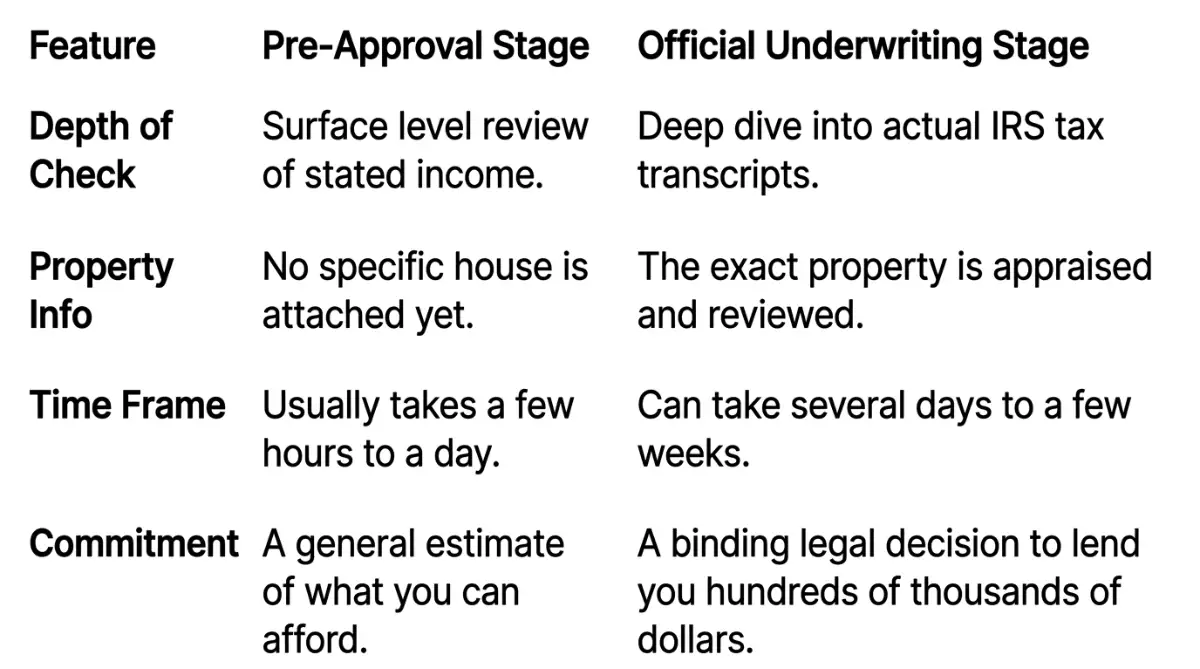
As you can see, getting past the initial pre-approval is only the warm-up. Now, let's explore the actual steps the underwriter takes when your file hits their desk.
Step 1: The Deep Dive Into Your Income Stability
The very first thing an underwriter wants to know is how you make your money. More importantly, they want to know if that money is going to continue flowing in the future.
It is not enough to just make a lot of money right now. Stability is the most important factor in the mortgage world. If you make a massive salary but switch jobs every two months, the bank will view you as a high risk.
How They Calculate Your True Earning Power
If you are a standard employee with a W-2 form, this process is fairly straightforward. The underwriter will look at your base salary and verify it with your employer.
However, things get complicated if you rely on overtime, bonuses, or commissions. An underwriter will usually average these extra earnings over the past 24 months. If your overtime is dropping recently, they might not count it at all.
The Self-Employed Reality Check
If you run your own business, the underwriter becomes a financial detective. They will not look at how much money your business makes; they look at what you report to the government after tax deductions.
Many business owners write off heavy expenses to save on taxes. While this is great for tax season, it shrinks your qualifying income on paper. You might feel rich in real life, but the underwriter only sees the smaller taxable number.
Step 2: Tracking Every Penny of Your Assets
Once the underwriter is happy with your income, they move on to your bank accounts. They need to verify that you actually have the money for the down payment and closing costs.
They will ask for your most recent bank statements, usually covering the last two months. But they are not just looking at your final balance. They are reading every single line item.
The Danger of Large, Unexplained Deposits
This is where many homebuyers accidentally sabotage their own loans. If the underwriter sees a random $5,000 deposit in your account, warning bells go off.
My biggest mistake was trying to be prepared by depositing a large amount of cash I had saved at home right into my bank account a week before applying. I quickly realized that banks absolutely hate untraceable money, and explaining it caused a massive, stressful delay with my underwriter. Always make sure your savings are sitting safely in your bank account months before you even start looking at houses!
They need to know exactly where that money came from. Did you sell a used car? Did your parents give you a gift? Or did you secretly take out a personal loan to cover your down payment?
Sourcing and Seasoning Your Funds
In the banking world, there is a concept called "sourcing and seasoning." Sourcing means you can prove exactly where the money originated with a paper trail.
Seasoning means the money has been sitting in your account for a while. If the money has been in your account for over sixty days, it is generally considered your own money. If a family member gives you cash to help buy the house, you will need a signed "gift letter" proving it is not a secret loan you have to pay back.
Step 3: Analyzing the Story Behind Your Credit
Most people think underwriters just look at a three-digit credit score and make a decision. The truth is far more detailed.
Your credit score gets you through the front door, but your actual credit report tells the story of your financial habits. The underwriter will read this report like a biography.
Debt-to-Income Ratio (DTI) Matters Most
Your DTI is the magic number in real estate finance. It compares how much you owe every month to how much you earn before taxes.
Even if you have a perfect credit score, a high DTI can ruin your chances. If too much of your monthly paycheck is eaten up by car loans and student debt, the bank will not want to add a massive mortgage payment on top of it.
Handling Credit Inquiries and Red Flags
The underwriter will look closely at any recent credit inquiries. If they see you applied for new credit cards right before buying a house, they will demand a written explanation.
Expert Tip: Never buy a car, finance furniture, or open a new credit card while you are in the underwriting phase. A new monthly payment can instantly change your DTI and cause your loan to be denied at the very last minute.
Step 4: Evaluating the Property as Collateral
Up until this point, the underwriter has only been judging you. Now, they must judge the house you want to buy.
Remember, if you stop making your payments, the bank will take the house. Therefore, they need to make sure the property is actually worth the money they are lending you.
The Appraisal Reality
The bank will send an independent appraiser to evaluate the home. If you offered $300,000 for a house, but the appraiser says it is only worth $270,000, you have a major problem.
The underwriter will only base the loan on the appraised value. You would either have to renegotiate the price with the seller or bring the extra $30,000 in cash to closing.
Health and Safety Inspections
Depending on the type of loan you are getting, the property must meet strict safety guidelines. Government loans like FHA or VA are incredibly strict about the physical condition of the house.
If the roof is caving in, or there is peeling lead-based paint, the underwriter will refuse to approve the loan until the seller fixes these issues. The house must be safe, sound, and structurally secure.
Common Myths About The Approval Process
Let's take a moment to bust some of the biggest myths that cause unnecessary stress for homebuyers.
Myth: The underwriter hates you and wants to deny your loan.
Reality: Underwriters want to approve your file. Lenders only make money when loans actually close. They are just following strict federal guidelines to protect everyone involved.
Myth: A single late payment from three years ago will destroy your chances.
Reality: Underwriters look for recent patterns of bad behavior. An isolated mistake from years ago, followed by excellent recent history, is usually very easy to explain with a simple letter.
Myth: You must pay off all your debt before getting a mortgage.
Reality: You just need your debt to be manageable. Having open, active credit lines actually proves you know how to borrow money responsibly.
How to Survive the Conditional Approval Stage
Eventually, the underwriter will issue something called a "Conditional Approval." This is a huge milestone, but you are not completely finished yet.
A conditional approval means they agree to give you the loan, provided you clear up a few final details. They might ask for an updated pay stub, a clearer copy of your ID, or a letter explaining a specific bank deposit.
Speed is Your Best Friend
When the underwriter asks for a document, you must provide it immediately. The faster you give them what they need, the faster you get your final clear to close.
Keep all your documents organized in a digital folder on your computer. Having your W-2s, tax returns, and bank statements ready to email at a moment's notice will make this entire process feel like a breeze.
Understanding the "why" behind an underwriter's requests changes your entire perspective. Instead of feeling attacked by a giant financial institution, you can view the process logically. You are simply providing proof that you are ready, willing, and able to take on the responsibility of homeownership.
Navigating the Final Approval Stages Like a Financial Expert
Getting a conditional approval from your lender feels amazing, but the journey is not quite over yet. You have passed the heavy scrutiny, but now you must navigate the delicate final stages of the process.
This phase is all about maintaining the exact financial profile you presented on day one. Any sudden shifts in your money habits can send your application straight back to the underwriter's desk.
To help you cross the finish line smoothly, I want to share some insider strategies. These are the exact methods professional real estate investors use to ensure their deals close on time, every single time.
Mastering the Art of the "Letter of Explanation"
During the final review, an underwriter might ask you to write a Letter of Explanation (often called a LOX). This request terrifies many buyers, but it is actually a very normal part of the process.
The underwriter just needs a written record to clear up a minor inconsistency in your file. For example, they might notice a large withdrawal from your savings account two months ago. They just need you to explain where that money went.
How to Write a Winning LOX
When writing this letter, keep your emotions completely out of it. The underwriter does not want a long, dramatic story about your life.
They simply want the plain facts. If you had a late payment on a medical bill, state exactly when it happened and why. Attach a receipt showing the bill is now paid in full. Keep the letter short, highly professional, and directly to the point.
Surviving the Secret "Soft Pull" Before Closing
Here is a major industry secret that catches thousands of buyers off guard. Just days before you sign the final papers, the lender will check your credit one last time .
This is known as a soft pull or a credit refresh. They do this to ensure you have not taken on any new debt since your initial application. If your debt levels have spiked, your entire loan could fall apart at the closing table.
Protecting Your Credit Profile
To survive this final check, you must keep your credit usage exactly the same as it was on day one. Do not close any old credit card accounts, and definitely do not open any new ones.
If you want to ensure your scores remain stable, you can read more about boosting your credit health rapidly. Small, consistent habits will keep your profile safe during this highly sensitive waiting period.
Strategic Rate Locking to Protect Your Budget
While your loan is sitting in underwriting, the global financial markets are constantly moving. This means the interest rate you were quoted on Monday might change by Friday.
To protect yourself from sudden price hikes, you will need to lock in your interest rate. A rate lock is a guarantee from the lender that your interest rate will not change for a specific period, usually thirty to sixty days.
When Should You Lock?
Locking your rate too early can be risky if your closing date gets delayed. If the lock expires before you sign the final papers, you might have to pay expensive extension fees.
You should always discuss the best timing with your loan officer. If you are exploring different loan structures, understanding adjustable versus fixed structures can also help you make a smarter decision about your long-term monthly payments.
For a completely unbiased look at how market rates fluctuate, you can always review the Consumer Financial Protection Bureau's advice on interest rates.

The Financial Traps That Instantly Destroy Mortgage Approvals
Before we discuss these dangerous traps, watch this quick video to see exactly how one innocent shopping trip can instantly cancel your home loan. It will completely change how you view your spending right now and motivate you to read the rest of the guide below so you can protect your dream home!
Over the years, I have seen perfectly good home loans fall apart at the very last minute. In almost every case, the buyer made a critical financial mistake right before closing day.
When you are in the underwriting phase, your financial life is effectively frozen. You cannot make sudden moves without facing severe consequences.
To keep your dream home safe, you must avoid these common, yet incredibly destructive, financial traps. Let's look at exactly what happens when you break the golden rules of underwriting.
Trap 1: The Furniture Financing Disaster
Imagine a buyer named Sarah. She just received her conditional approval and is thrilled about her new house. She decides to visit a local furniture store to buy a new living room set.
The store offers her a "zero percent financing for twelve months" deal. Sarah signs the paperwork, thinking she scored a great bargain. She has no idea she just killed her mortgage application.
The Underwriter's Perspective
When the lender runs that final credit check, they see a brand new debt obligation under Sarah's name. This new monthly furniture payment increases her debt-to-income ratio.
Because her debts are now higher, she no longer qualifies for the original mortgage amount. She loses the house, all because she bought a couch two weeks too early. Never buy anything on credit until after you have the keys in your hand.
Trap 2: The Sudden Job Switch
We all want a better career, but the middle of a mortgage application is the worst time to switch jobs. Lenders crave stability above everything else.
Even if you are leaving your current job for a higher-paying position, changing companies creates a massive red flag. The underwriter will immediately pause your loan to investigate.
The Probationary Period Problem
Many new jobs come with a standard probationary period. Underwriters hate probationary periods because your employment is not considered fully permanent yet.
If you absolutely must change jobs, you have to inform your loan officer immediately. They will likely need an official offer letter and your first new pay stub before they can proceed. It is always safer to delay your start date until after you close on the house.
Trap 3: Playing Banker for Friends and Family
You might have a family member who needs a little help buying a car or renting an apartment. Out of the goodness of your heart, you agree to co-sign the loan for them.
This is a terrible mistake while buying a house. When you co-sign a loan, you are legally responsible for that entire debt. The underwriter will treat that new car payment as if it belongs entirely to you .
The Hidden Debt Burden
Even if your relative makes every payment on time, the debt still sits on your credit report. This will heavily damage your borrowing power.
If you want to understand the deep financial risks involved, I highly recommend reading about how co-signing affects your debt profile from trusted financial experts. Always put your own housing needs first and politely decline any co-signing requests.
Trap 4: The Mattress Money Mystery
Many hardworking people like to keep physical cash safely tucked away at home. While saving money is great, physical cash is completely useless in the mortgage world.
If you suddenly deposit five thousand dollars of physical cash into your bank account, the underwriter will panic. They cannot trace where that money came from .
Anti-Money Laundering Strictness
Lenders are bound by strict federal laws to prevent money laundering. They must be able to track every single dollar used in a real estate transaction.
Because cash has no paper trail, the underwriter will refuse to count it toward your down payment. To avoid this headache, you must practice organizing your financial documents perfectly well before you apply for the loan. All money should be sitting in a verifiable bank account for at least two months.
Expert Q&A: Real Questions from Nervous Buyers
To give you even more clarity, let's address some of the most common questions buyers ask during the final waiting period.
Question: Can I still use my credit card for daily groceries?
Yes, you absolutely can. Lenders know you need to buy food and gas. The secret is to keep your spending habits completely normal. Just pay off your balance on time and do not make any unusually large purchases.
Question: What if the seller delays the closing date?
This happens quite often due to moving delays or title issues. If the closing is delayed, you need to check your rate lock expiration date. You might need to ask your loan officer to negotiate a free rate extension while you wait .
Question: Can I pay off my car loan during underwriting to lower my debt?
You should never pay off a large debt without asking your loan officer first. While it seems like a smart move, paying off an installment loan can temporarily drop your credit score. Always let your loan officer run a simulation before you spend your cash.
Your Ultimate Action Plan for Closing Day
You have successfully navigated the complexities of income verification, asset sourcing, and credit checks. The finish line is finally in sight.
When you finally receive those three magical words—"Clear to Close"—you can breathe a massive sigh of relief. This means the underwriter has signed off on everything, and the bank is officially ready to wire the funds.
To ensure your actual closing day goes perfectly, I have put together a final rapid-fire checklist for you.
The Final Week Checklist
- Review Your Closing Disclosure (CD): By law, you must receive this document three days before closing. Read it carefully to ensure the interest rate and final cash required match what you expected.
- Schedule the Final Walkthrough: Visit the empty house one last time before signing. Make sure the seller left the property in good condition and completed any agreed-upon repairs.
- Arrange Your Wire Transfer: Find out exactly how much money you need to bring to closing. Most title companies require a certified bank wire rather than a personal check. Beware of wire fraud and always verify the account numbers over a phone call .
- Bring Your Physical ID: You will be signing a massive stack of legal documents. Make sure your driver's license or passport is valid and not expired.
A Final Word of Encouragement
Buying a home is one of the largest and most rewarding financial transactions of your entire life. Yes, the paperwork is exhausting. Yes, the waiting period can test your patience.
But you now possess the knowledge to handle this process like a true professional. You know exactly what the bank wants, and you know how to avoid the hidden traps that catch other buyers off guard.
Stay organized, communicate openly with your lending team, and keep your financial habits incredibly boring for the next few weeks. Before you know it, you will be holding the keys to your new front door, ready to start the next beautiful chapter of your life.
The day I finally got my "Clear to Close" email, all those weeks of lost sleep and endless paperwork instantly faded away. You already know exactly what mistakes to avoid now, so take a deep breath, keep your spending perfectly boring, and trust the process. You are so close to holding those keys, and I promise you, the amazing feeling of opening your own front door is absolutely worth it!
Financial Disclaimer: The information provided in this article is for educational and informational purposes only and does not constitute financial, legal, or real estate advice. Mortgage guidelines, interest rates, and lending requirements vary by institution and change frequently. Always consult with a licensed mortgage broker, loan officer, or financial advisor to discuss your specific personal situation before making any major financial decisions.
THANK YOU