
The Hidden Cost of Ignoring the Digital Financial Revolution
It happens at family dinners, and it happens at the office water cooler. Someone brings up digital assets, and suddenly, you feel like you are speaking a completely different language. You smile and nod, but inside, a tight knot of anxiety forms in your stomach.
I remember sitting at a family dinner two years ago, completely silent while my cousins talked about their digital asset portfolios. I felt so embarrassed and left behind, assuming I just wasn't smart enough to figure it all out. It took me months of painful mistakes to realize that the tech wasn't too hard for me—the information online was just poorly explained.
Everyone around you seems to be making smart financial moves while you are stuck on the sidelines. You genuinely want to learn, so you try searching for the basics online. However, within five minutes, you are drowning in complex technical jargon.
Words like "hash rates" and "decentralized finance" make your head spin instantly. It feels incredibly frustrating to want to educate yourself, only to hit a massive wall of confusing tech talk.
When you finally dive into online forums, the real nightmare begins. The internet is packed with confusing, conflicting, and often dangerous financial advice.
- Fake investment gurus: You easily stumble across self-proclaimed experts who promise massive wealth overnight, pushing you toward extremely high-risk decisions.
- Overly complex guides: Most articles are written by software developers, for other developers, completely ignoring the absolute beginner who just needs simple English.
- Hidden scams and hype: Misleading influencers constantly promote useless digital tokens, masking them as the next big breakthrough in financial technology.
- Information overload: With hundreds of new technical terms appearing weekly, beginners absolutely cannot tell the difference between a solid educational resource and a paid scam.
This constant exposure to bad information takes a heavy toll on your daily life. It slowly chips away at your peace of mind and ruins your confidence as a modern investor.
- Endless second-guessing: You constantly lose sleep wondering if you are missing out on the greatest wealth transfer in history, or if you are safely avoiding a massive financial bubble.
- Fear of looking foolish: You completely stop asking questions in public forums or among friends, terrified that someone will laugh at your lack of technical knowledge.
- Decision paralysis: Because you cannot easily separate facts from internet hype, you end up doing nothing at all, which only fuels your inner anxiety.
- Deep financial stress: The constant worry about inflation shrinking your traditional savings makes you feel trapped, yet the fear of losing money to digital scams keeps you completely frozen.
The Beginner’s Blueprint: Decoding the Digital Ledger
If you want to make smart decisions in the modern financial market, you must understand the machinery running behind the scenes. You cannot become a successful investor simply by guessing or following random social media trends.
To build real confidence, you need to strip away the complex computer science terminology. We are going to break down this amazing technology into incredibly simple, bite-sized pieces.
Think of this as your personal roadmap to understanding the technology that is actively reshaping global finance. Let us walk through the most practical and logical steps to master these foundational concepts today.
Step 1: Grasping the "Shared Notebook" Concept
The easiest way to understand this technology is to think about a simple notebook used by a group of friends. Imagine you and your friends share a notebook to keep track of who owes money for dinner.
In a traditional banking system, only one person gets to hold the notebook. If that person makes a mistake, loses the notebook, or decides to cheat, everyone else suffers the consequences. Traditional banks hold the ultimate power over your financial data.
Now, imagine a magical notebook where every single friend gets an exact copy instantly. Whenever someone buys a pizza and updates their notebook, everyone else’s notebook updates automatically.
Pro Tip: This shared notebook concept is exactly what experts mean when they say "Distributed Ledger Technology." It simply means the record book is shared across thousands of computers globally, rather than sitting in one secret bank vault.
Because everyone has a copy, nobody can sneakily erase a debt or add fake money. If one person tries to change their notebook to say they have a million dollars, the other notebooks will quickly reject the fake update.
This brings us to the very first scientific pillar of this technology: complete transparency. You no longer have to blindly trust a massive corporation to handle your numbers honestly.
If you are still having a hard time picturing how this "shared notebook" actually works in real life, watch this quick visual breakdown below. It completely cleared up my confusion in just a few minutes, and the steps we cover right after the video will make so much more sense once you see it!
Step 2: Unmasking the Magic of Decentralization
You hear the word "decentralization" thrown around constantly in investment circles. While it sounds like a complex mathematical theory, it is actually a very simple shift in power dynamics.
Decentralization simply means there is no central boss, no CEO, and no headquarters controlling the network. Instead of a bank holding your funds and approving your transfers, a global network of independent computers works together.
- Real-Life Scenario: If you want to send money to a relative overseas on a Friday night, traditional banks will make you wait until Monday. They will also charge you a massive international transfer fee just for using their service.
- The Decentralized Solution: With digital ledgers, you can send that exact same value on a Saturday at 3 AM. The network processes the transaction in minutes, without any bank manager needing to approve it.
This removes the expensive middlemen from our daily financial lives. When you cut out the middlemen, you drastically reduce transaction fees and completely eliminate frustrating waiting periods.
Expert Insight: Understanding decentralization is the single most important skill for a new investor. Once you realize that nobody can arbitrarily freeze your account or block a transaction, you begin to see the true value of these digital assets.
Myth vs. Reality: Clearing the Fog
Before we move on to the security aspects, we need to completely destroy a very common misconception.
The Myth: People believe this technology is strictly a secret tool used by criminals to hide their dark web transactions.
The Reality: A public digital ledger is actually the worst possible place for a criminal to hide. Every single transaction is permanently recorded and visible to the entire world forever.
Law enforcement agencies globally use these transparent public ledgers to track down bad actors with incredible accuracy. It is significantly easier to hide illegal activities using physical paper cash than it is on a public digital network.
Step 3: The Unbreakable Chain of Cryptographic Blocks
Now that you understand the shared notebook, let us talk about how this system stays so incredibly secure. This is where the actual "block" and "chain" part of the name comes from.
Instead of writing lines on a paper page, computers bundle recent transactions together into a digital file. This digital file containing the latest transactions is called a "block."
Once a block is completely full of verified transactions, it gets locked tightly using advanced mathematics. Think of this mathematical lock as a unique digital fingerprint.
How the Connection Works:
Every new block that gets created must include the exact digital fingerprint of the block that came right before it. Because they share fingerprints, they become permanently linked together in a long, unbroken chain.
If a hacker tries to go back in time and change a transaction in an old block, the fingerprint of that block instantly changes. Because the fingerprint changed, the next block in the chain will no longer recognize it.
This mismatch immediately triggers a massive alarm across the entire global network. The thousands of other computers will instantly reject the hacker's tampered version and restore the original, truthful record.
This brilliant use of mathematics makes the system practically impossible to hack from the outside. For a beginner investor, this means the foundation holding your digital assets is built on military-grade security logic.
Comparing the Old World with the New World
To make this completely clear, let us look at a direct comparison between your current banking system and a decentralized ledger. Seeing the differences side-by-side helps cement these concepts in your mind permanently.
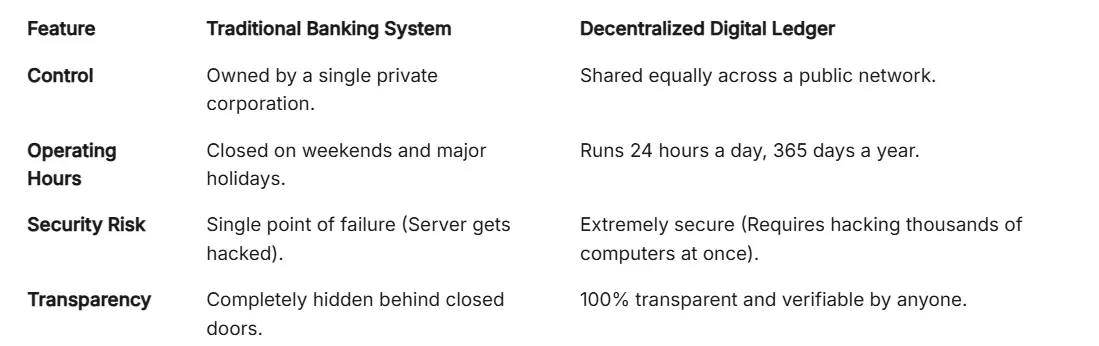
When you study this table, the real investment value of this technology becomes undeniably clear. You are not just buying imaginary internet coins; you are investing in a completely upgraded financial infrastructure.
Step 4: The Role of Network Validators (Nodes)
We have talked about the thousands of computers that hold copies of the notebook, but what exactly are they? In the tech world, these independent computers are known as "Nodes."
Anyone with a decent computer and an internet connection can voluntarily become a node in the network. These nodes act as the unpaid auditors and security guards of the digital ecosystem.
When you request to send a digital asset to your friend, your request gets broadcasted out to all these nodes. The nodes immediately race to check your account history to ensure you actually have the funds you are trying to send .
If the majority of the nodes agree that your request is totally valid, they give the green light. The transaction gets bundled into the next block, and the transfer is permanently finalized.
- The Power of Consensus: This agreement process is known as reaching a "consensus." It is a highly democratic process where truth is determined by mathematics rather than human opinions.
- Why It Matters: Because no single node has absolute authority, no individual can push through a fraudulent transaction. This mathematical harmony is what gives digital assets their trusted global value.
By taking the time to understand these underlying mechanics, you are already miles ahead of the average internet investor. You are transitioning from a confused bystander into an educated participant who understands exactly what they are looking at.
Leveling Up: Professional Strategies for the Digital Economy
Now that you completely understand the basic shared notebook concept, it is time to move forward. You are no longer standing on the sidelines watching everyone else make moves.
You have the foundational knowledge, but the real magic happens when you apply advanced strategies. We are going to explore how professional investors secure their digital wealth and sleep peacefully at night.
The secret to long-term success in the digital market is not about getting lucky. It is about building a completely bulletproof system that protects your money from unexpected market crashes.
Let us walk through some incredibly powerful concepts that will immediately put you ahead of 90% of new investors.
The Magic of Automated Digital Agreements
One of the most fascinating features of this technology is something called a "smart contract." While the name sounds intimidating, it is actually just a simple set of digital instructions.
Think of a smart contract exactly like a physical vending machine. When you walk up to a vending machine, you do not need a cashier to hand you a soda. You insert your money, press a button, and the machine automatically drops your drink.
The machine is programmed with a strict set of rules. If you put in a dollar, you get a bottle of water. If you do not put in enough money, the machine returns your coins instantly.
Pro Tip: Smart contracts work exactly the same way, but for complex financial deals. They are tiny pieces of computer code that automatically transfer digital assets when specific conditions are met.
For example, you could set up an agreement to pay a freelance graphic designer automatically. The moment they submit their finished artwork to the network, the smart contract instantly releases their payment.
There are no late fees, no waiting for bank approvals, and no arguments over invoices. If you want to deeply understand how these automated systems are replacing traditional lawyers and bankers, I highly recommend reading Investopedia's excellent breakdown of smart contracts.
Building a Fortress Around Your Wealth
When you use traditional banks, the bank acts as your security guard. If someone steals your credit card, you simply call the bank and they reverse the fraudulent charges.
In the decentralized digital world, you are your own bank. While this gives you absolute financial freedom, it also gives you complete responsibility for your own security.
Many beginners make the terrible mistake of leaving their newly purchased assets on public trading websites. This is like buying solid gold bars and leaving them sitting on the counter at a public grocery store.
If you plan to hold onto your digital investments for months or years, you absolutely must move them off the internet. You need to transition your funds into a physical security device.
Taking control of your private security is a non-negotiable step. For a complete, step-by-step tutorial on how to completely protect yourself from online hackers, you should carefully read our guide on safely storing your digital assets offline.
The Psychology of a Master Investor
The digital market is famous for wild price swings. One week, prices are shooting to the moon, and the next week, everything seems to be crashing down.
Average people let their emotions completely control their financial decisions. They buy assets when they feel greedy and sell everything at a massive loss when they feel panicked.
Successful investors completely remove emotions from the equation. They do not sit at their computers trying to perfectly guess the highest or lowest price of the day.
Instead, they use a boring but incredibly effective mathematical strategy. They commit to investing a small, fixed amount of money on the exact same day every single week.
- Real-Life Scenario: Imagine Sarah decides to buy exactly $50 worth of a digital asset every Friday morning. She does this regardless of whether the market is having a great week or a terrible week.
- The Result: Over several months, Sarah naturally buys more when prices are cheap and less when prices are expensive. Her average purchase price completely smooths out over time.
This simple habit protects your mental health and prevents terrible impulse decisions. If you want to learn exactly how to set up this automated wealth-building system, check out our beginner-friendly tutorial on building wealth through dollar-cost averaging.
The Financial Minefield: Dangerous Traps for Unsuspecting Beginners
Every single day, thousands of enthusiastic people enter the digital market hoping to improve their financial future. Unfortunately, a huge percentage of these beginners lose their money within the first few weeks.
They do not lose their money because the technology is broken. They lose their hard-earned cash because they step right into highly predictable and completely avoidable traps.
My goal is to protect your capital. Let us clearly identify the most dangerous pitfalls on this journey so you can confidently walk right around them.
Trap 1: The "Lost Key" Catastrophe
In your normal internet life, forgetting a password is only a minor inconvenience. You simply click the "Forgot Password" link, check your email, and reset your account in two minutes.
The digital ledger world does not have a customer service department. When you create a secure digital wallet, you are given a completely unique "Private Key," which usually looks like a random list of 12 or 24 words.
This specific list of words is the only way to access your funds. If you lose those words, your money is permanently gone.
There is no manager to call, no email reset link, and no way to hack your way back inside. Millions of dollars are currently sitting locked away forever simply because early investors accidentally threw away their paper notebooks.
How to avoid this: Write your recovery words down on a physical piece of paper and lock it inside a fireproof safe. Never take a digital photo of these words, and never save them on your computer.
I learned this lesson the hard way when I lost a notebook during a house move and permanently locked myself out of my very first digital wallet. Since that painful day, I always keep two physical copies of my recovery words hidden in completely separate, secure locations. Trust me, you do not want to skip this easy step!
Trap 2: Chasing Internet Hype and Fake Gurus
Social media is heavily flooded with self-proclaimed financial experts driving expensive sports cars. These influencers constantly promise to share secret coins that will supposedly make you a millionaire overnight.
This is almost always a modern version of the classic pump-and-dump scam. The influencer secretly buys a massive amount of a completely worthless digital token.
Next, they make exciting YouTube videos telling their followers to buy the token immediately. When the followers rush in to buy, the price artificially shoots up.
Once the price is high enough, the influencer sells all their tokens for a massive profit. The price instantly crashes to zero, leaving the beginners holding completely worthless digital trash.
Before you ever spend a single dollar, you must educate yourself on how to spot these aggressive internet frauds. The Federal Trade Commission guidelines on avoiding digital investment scams provides an excellent, trusted resource for identifying financial red flags.
Trap 3: Ignoring the Hidden Network Toll Booths
When you swipe a standard debit card at a coffee shop, you do not pay a fee for using the card. The merchant secretly absorbs the tiny processing fee on your behalf.
Because decentralized networks do not have a central company paying the bills, the users must pay a small fee to keep the network running. In the industry, this is often called a "Gas Fee."
These network fees change constantly based on how busy the internet traffic is. If millions of people are trying to use the network at the exact same time, the fees skyrocket.
- The Big Mistake: A beginner might try to send a $20 payment during a massive network traffic jam.
- The Shocking Consequence: They end up paying a $35 network fee just to send their $20 transaction.
Always look closely at the estimated network fee before you hit the final confirmation button. If the fees seem unusually high, simply wait a few hours for the global network traffic to calm down.
Trap 4: Trusting Third-Party Exchanges with Your Life Savings
We briefly touched on this earlier, but it is so important that it deserves its own dedicated warning. Using a public digital exchange is perfectly fine for buying and selling assets quickly.
However, an exchange is not a digital bank vault. When your money is sitting on an exchange website, you do not actually own those digital assets.
The exchange holds the master keys, and they simply show you an IOU on your computer screen. If that specific company goes bankrupt, gets hacked, or gets shut down by the government, your money is trapped.
We have seen multiple massive global exchanges suddenly collapse without any warning. People who trusted these platforms lost their entire life savings in a matter of hours. Always transfer significant amounts of wealth to your own private security device.
Trap 5: Forgetting About Real-World Financial Health
It is incredibly easy to become completely obsessed with digital charts and decentralized technology. Some beginners get so caught up in the digital world that they completely neglect their traditional personal finances.
They max out their standard credit cards to buy digital assets, assuming they will easily pay off the debt later. This is an extremely dangerous game that usually ends in disaster.
Your real-world financial health still deeply matters. If you want to buy a house, rent a nice apartment, or finance a safe car, the traditional banking system still holds the keys.
Never sacrifice your real-world stability for a digital gamble. Make sure you are paying your standard bills on time and actively improving your credit score fast while you explore these exciting new investments.

Your Personal Action Plan: Turning Knowledge into Power
You have officially absorbed more factual, high-quality information today than most average investors learn in their first six months. You know how the shared notebook works, you understand mathematical security, and you know exactly which dangerous traps to avoid.
Reading this guide was a fantastic first step, but reading alone will not change your financial future. Wealth is built by taking slow, calculated, and consistent actions based on solid education.
It is completely normal if you still feel slightly nervous about making your very first move. We are going to eliminate that remaining anxiety right now with a very simple, practical checklist.
The 48-Hour Starter Checklist
Do not try to master the entire global financial market in a single afternoon. Instead, focus entirely on checking off these three simple tasks within the next 48 hours.
- Define Your True Budget: Sit down with a calculator and figure out exactly how much money you can easily afford to lose. Never invest your rent money, your grocery budget, or your emergency savings.
- Choose a Regulated Platform: Ignore the highly aggressive social media influencers. Do a quick search for top-tier, legally regulated digital asset exchanges that operate safely within your specific country.
- Start Uncomfortably Small: Once your account is set up, buy a tiny fraction of a widely recognized digital asset. Spend exactly $10. Watch how the transaction works, see how the fees apply, and experience the process without any serious financial risk.
By starting incredibly small, you completely remove the heavy pressure of making a huge mistake. You are simply paying a $10 tuition fee to interact with the greatest financial experiment of our generation.
A Final Word From the Expert
You do not need a computer science degree or a background in Wall Street banking to succeed here. The people who win in this market are simply the ones who stay patient, ignore the wild internet rumors, and stick to their personal plans.
Every single expert who currently manages millions of dollars started exactly where you are sitting right now. They stared at a confusing computer screen, felt slightly overwhelmed, and decided to push forward anyway.
Take a deep breath and trust the educational foundation you just built today. You have the right mindset, you have the necessary tools, and you are completely ready to take control of your financial destiny.
Looking back, finally taking that first step and buying just a tiny piece of a digital asset was the best financial move I ever made. The fear goes away the moment you actually try it yourself. Start small today, keep learning, and I promise this whole digital world will feel like second nature to you in no time.
Financial Disclaimer: The information provided in this article is strictly for educational and informational purposes only. It does not constitute professional financial, investment, or legal advice. Digital assets are highly volatile, and you should always conduct your own extensive research or consult with a licensed financial advisor before making any investment decisions. Never invest money you cannot afford to lose.
***THANK YOU***